Showing posts with label Khanate Bukhara. Show all posts

Tuesday, December 6, 2022

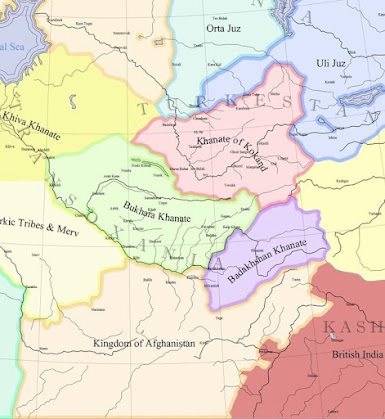
Khanate of Bukhara (1500 to 1920)

It received this name when the capital of the Shaybanid state (1506–1598) was moved to Bukhara. The khanate of Bukhara, which reigned between 1500 and 1920, was the longest surviving Turkish-Islamic State after the Ottoman Empire. The Shaybanid dynasty ruled the Khanate from 1506 to 1598. Under their rule, Bukhara became a center of arts and literature and educational reforms were introduced.

From 1533 to 1540, Bukhara briefly became its capital during the reign of Ubaydallah Khan. The khanate reached its greatest extent and influence under its penultimate Abu'l-Khayrid ruler, the scholarly Abdullah Khan II (r. 1557–1598).

In the 17th and 18th centuries, the Khanate was ruled by the Janid Dynasty (Astrakhanids or Hashtarkhanids). They were the last Genghisid descendants to rule Bukhara.

In 1740 it was conquered by Nadir Shah. After his death, in 1747, the khanate was controlled by the descendants of the Uzbek emir Khudayar Bi, through the prime ministerial position of ataliq.

In 1785, his descendant, Shah Murad, formalized the family's dynastic rule (Manghit dynasty), and the khanate became the Emirate of Bukhara.

The late nineteenth century saw commercial and diplomatic ties with Russia give way to armed conflict soon after the Russian conquest of Tashkent (1865). In 1920 the former khanate became the Bukharan People's Soviet Republic, dissolving into the Soviet republic of Uzbekistan in 1924.
Khanate of Bukhara (1500 to 1920)

Saturday, January 29, 2022

Janid Dynasty

In the 17th and 18th centuries, the Khanate was ruled by the Janid Dynasty (Astrakhanids or Toqay Timurids). They were the last Genghisid descendants to rule Bukhara.

By 1510 the Uzbeks had completed their conquest of Central Asia, including the territory of the present-day Uzbekistan. From 1533 to 1540, Bukhara briefly became its capital during the reign of Ubaydallah Khan. The Khanate reached its greatest extent and influence under its penultimate Shaybanid ruler, the scholarly Abdallah Khan II. When Abdallah II died in 1598, his son and successor Abdalmumin, who had spent a number of years as governor of Balkh, managed to stay on the throne only a few months before he was ousted and killed in the disorders that followed his father's death.

In 1556. Jani Muhammad (brother-in-law of Abdallah) married the Uzbek khan's sister, and he acceded to the vacated throne in Bukhara as the first ruler of a dynasty called Janid or Ashtarkhanid; descendants of another line of the Jochids, not through Shiban but through Tuqay Timur, one of Juchi's other sons. although some territory was lost, the political stability and economic well-being of the state were not immediately affected.

The khans of Ḵīva, beginning with Abuʾl-Ḡāzī (1644-64), took advantage of Janid difficulties and repeatedly raided Transoxiana, often penetrating to its central regions.

The Janid dynasty, ruled Transoxania after 1599. Under their rule the city and khanate crystallized into an almost classical pattern of a Muslim polity of its time, cherishing and even enhancing traditional values. The Janid dynasty is considered to have had a strong Muslim influence and promoted the construction of a large number of mosques and madrasas.

From the elevated political and cultural accomplishments of the Shaybānids, the level and extent of Uzbek influence slid into decline under Ashtarkhanid rule, reaching a low point by the mid-1700s. In 1740, it was conquered by Nader Shah, the Shah of Iran.
Janid Dynasty

The top most popular articles